General Chemistry I – Overview
General Chemistry I introduces the fundamental principles that govern matter and its transformations. It covers atomic structure, chemical bonding, stoichiometry, thermochemistry, and states of matter. The course begins with an understanding of atoms—protons, neutrons, and electrons—and progresses to electron configurations, periodic trends, and how these influence chemical behavior. The periodic table becomes a powerful tool to predict properties such as atomic size, ionization energy, and electronegativity.
A major component of General Chemistry I is stoichiometry, which deals with quantitative relationships in chemical reactions. Students learn to balance chemical equations and calculate amounts of reactants and products using the mole concept. This includes topics like limiting reagents, percentage yield, empirical and molecular formulas, and solution concentrations. These calculations are essential for laboratory work and industrial chemistry processes.
Another key area is energy changes in chemical reactions (thermochemistry). This includes concepts such as enthalpy, exothermic and endothermic reactions, calorimetry, and Hess’s law. Additionally, students explore gases and their behavior using gas laws such as Boyle’s law, Charles’s law, and the ideal gas equation. Together, these topics build a strong foundation for understanding more advanced chemistry concepts.
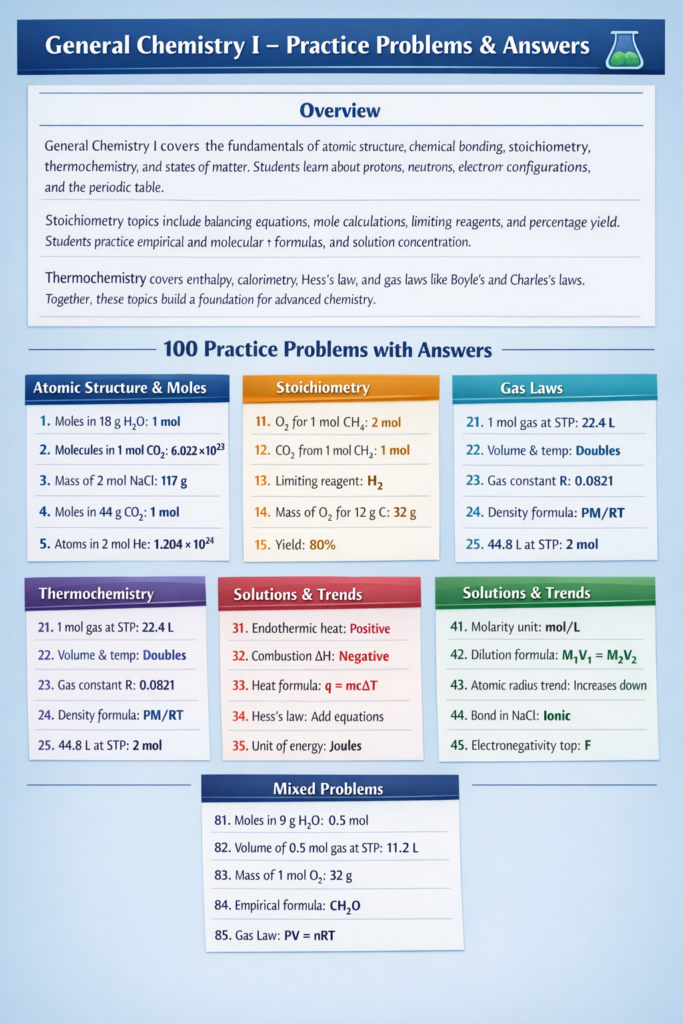
100 Practice Numerical Problems with Answers
Atomic Structure & Mole Concept
- Number of moles in 18 g of water
Answer: 1 mol - Number of molecules in 1 mol of CO₂
Answer: - Mass of 2 mol NaCl
Answer: 117 g - Moles in 44 g CO₂
Answer: 1 mol - Number of atoms in 2 mol He
Answer: - Molar mass of H₂SO₄
Answer: 98 g/mol - Mass of 0.5 mol O₂
Answer: 16 g - Moles in 22 g N₂
Answer: 0.786 mol - Molecules in 0.5 mol H₂O
Answer: - Atoms in 1 mol CH₄
Answer:
Stoichiometry
- Moles of O₂ needed for 1 mol CH₄ combustion
Answer: 2 mol - CO₂ formed from 1 mol CH₄
Answer: 1 mol - Mass of CO₂ from 1 mol C
Answer: 44 g - Limiting reagent: 2 mol H₂ + 1 mol O₂
Answer: H₂ - Water formed from 2 mol H₂
Answer: 2 mol - Mass of O₂ needed for 12 g C
Answer: 32 g - Moles of NaCl from 1 mol Na
Answer: 1 mol - Yield if actual = 80 g, theoretical = 100 g
Answer: 80% - Empirical formula of CH₂O
Answer: CH₂O - Molecular formula if molar mass = 180
Answer: C₆H₁₂O₆
Gas Laws
- Volume at STP of 1 mol gas
Answer: 22.4 L - Pressure if volume halves (Boyle’s law)
Answer: Doubles - Volume change if temperature doubles (Charles’s law)
Answer: Doubles - Pressure of 1 mol gas at 22.4 L, 273 K
Answer: 1 atm - Gas constant R
Answer: 0.0821 L·atm/mol·K - Moles in 44.8 L gas at STP
Answer: 2 mol - Volume of 2 mol gas at STP
Answer: 44.8 L - Temperature if pressure doubles (constant volume)
Answer: Doubles - Density of gas formula
Answer: PM/RT - Pressure of gas with n=1, T=300K, V=24.6L
Answer: 1 atm
Thermochemistry
- Heat absorbed in endothermic reaction
Answer: Positive - Heat released in exothermic reaction
Answer: Negative - Specific heat formula
Answer: q=mcΔT - Heat for 1 g water, ΔT=10°C
Answer: 41.8 J - Enthalpy change unit
Answer: kJ/mol - ΔH for combustion is
Answer: Negative - Hess’s law application
Answer: Add equations - Calorimeter measures
Answer: Heat - Heat capacity unit
Answer: J/°C - Energy unit SI
Answer: Joule
Solutions & Concentration
- Molarity =
Answer: mol/L - Moles in 1 M, 1 L solution
Answer: 1 mol - 0.5 M solution means
Answer: 0.5 mol/L - Dilution formula
Answer: - 1 L of 2 M → diluted to 2 L
Answer: 1 M - Mass of NaCl in 1 L of 1 M solution
Answer: 58.5 g - ppm means
Answer: mg/L - Mole fraction formula
Answer: moles/total moles - Solubility unit
Answer: g/L - Normality =
Answer: eq/L
Periodic Trends
- Atomic radius increases
Answer: Down group - Ionization energy increases
Answer: Across period - Most electronegative element
Answer: F - Metallic character increases
Answer: Down group - Smallest atom
Answer: He - Largest atom
Answer: Cs - Electron affinity highest
Answer: Cl - Shielding effect increases
Answer: Down group - Valency of Group 1
Answer: 1 - Valency of Group 17
Answer: 1
Chemical Bonding
- Bond in NaCl
Answer: Ionic - Bond in H₂
Answer: Covalent - Shape of CH₄
Answer: Tetrahedral - Bond angle in CH₄
Answer: 109.5° - Hybridization in CH₄
Answer: sp³ - Hybridization in C₂H₂
Answer: sp - Polar molecule example
Answer: H₂O - Nonpolar molecule
Answer: CO₂ - VSEPR theory predicts
Answer: Shape - Lone pair reduces angle
Answer: Yes
States of Matter
- Gas compressibility
Answer: High - Liquid volume
Answer: Fixed - Solid shape
Answer: Fixed - Intermolecular forces strongest in
Answer: Solids - Boiling point increases with
Answer: IMF strength - Vapor pressure increases with
Answer: Temperature - Ideal gas assumption
Answer: No interactions - Real gas deviation at
Answer: High pressure - Diffusion rate ∝
Answer: 1/√M - Graham’s law
Answer: Rate ratio = √(M₂/M₁)
Mixed Problems
- Moles in 9 g water
Answer: 0.5 mol - Volume of 0.5 mol gas at STP
Answer: 11.2 L - Mass of 1 mol O₂
Answer: 32 g - Atoms in 1 mol O₂
Answer: - Pressure at half volume
Answer: Doubles - Heat if ΔT negative
Answer: Released - 1 mol ideal gas at 300K volume
Answer: 24.6 L - Molarity of 2 mol in 1 L
Answer: 2 M - Empirical formula from 40%C, 6.7%H, 53.3%O
Answer: CH₂O - Limiting reagent concept
Answer: Smallest product - Mass of 2 mol CO₂
Answer: 88 g - Density of gas at STP
Answer: M/22.4 - Bond angle NH₃
Answer: 107° - Hybridization NH₃
Answer: sp³ - Energy released sign
Answer: Negative - Volume doubles → pressure
Answer: Halves - Temperature unit SI
Answer: Kelvin - Moles = mass/molar mass
Answer: Formula - Avogadro number
Answer: - Gas equation
Answer: PV=nRT