General Chemistry Practice Problems with Answers (PDF) – Overview
A general chemistry practice problems with answers PDF is a structured resource designed to help students strengthen their understanding of fundamental chemistry concepts through problem-solving. These PDFs typically cover a wide range of topics such as atomic structure, stoichiometry, thermodynamics, chemical equilibrium, kinetics, and electrochemistry. They are especially useful for high school, undergraduate students, and competitive exam aspirants because they combine theory-based questions with numerical applications.
Such practice materials are valuable because chemistry is not just conceptual—it requires strong analytical and calculation skills. By working through numerical problems, students learn how to apply formulas, interpret data, and solve real-world chemical scenarios. These PDFs often include step-by-step solutions, helping learners identify mistakes and understand the correct approach. This makes them ideal for self-study, revision, and exam preparation.
Additionally, these resources are commonly used by educators to design assignments, quizzes, and exams. A well-prepared problem set improves problem-solving speed, accuracy, and confidence. Regular practice also helps in mastering units, significant figures, dimensional analysis, and formula derivations—essential skills for success in chemistry.
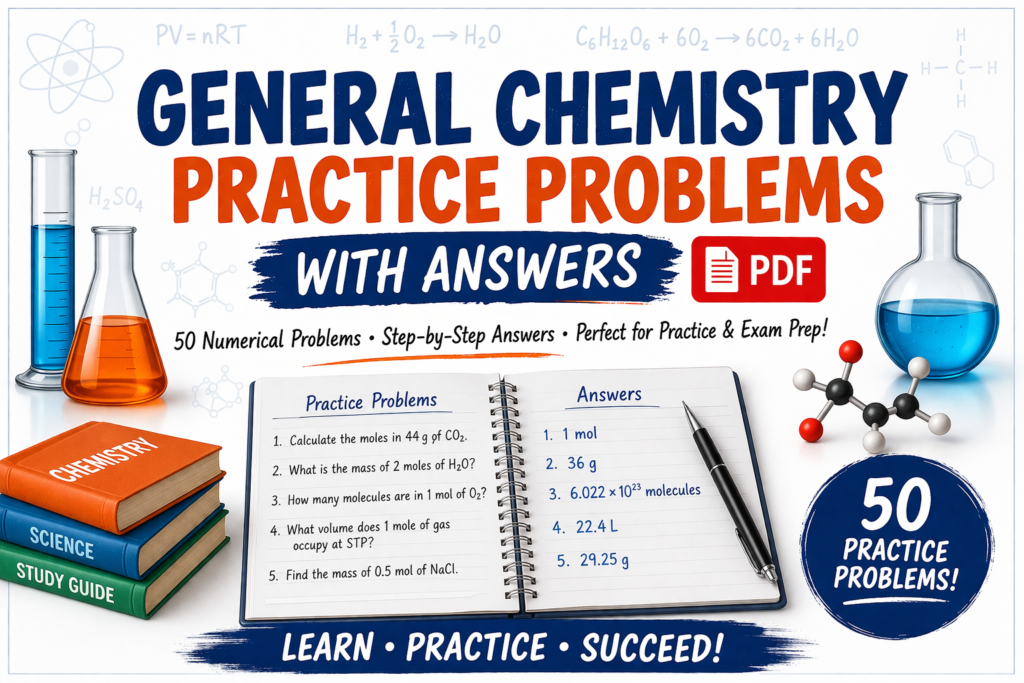
50 General Chemistry Numerical Problems with Answers
1–10: Mole Concept & Stoichiometry
- Calculate moles in 44 g of CO₂.
Answer: 1 mol - Mass of 2 moles of H₂O?
Answer: 36 g - Number of molecules in 1 mol of O₂?
Answer: 6.022 × 10²³ - Moles in 22.4 L of gas at STP?
Answer: 1 mol - Mass of 0.5 mol NaCl?
Answer: 29.25 g - Empirical formula of CH₂O (given)?
Answer: CH₂O - Molar mass of H₂SO₄?
Answer: 98 g/mol - Limiting reagent in 2H₂ + O₂ → 2H₂O if 2 mol H₂, 0.5 mol O₂?
Answer: O₂ - Mass of CaCO₃ needed to produce 44 g CO₂?
Answer: 100 g - % yield if theoretical = 50 g, actual = 40 g?
Answer: 80%
11–20: Gas Laws
- Volume of 1 mol gas at STP?
Answer: 22.4 L - Pressure when volume halves (Boyle’s law)?
Answer: Doubles - Volume at 600 K if 300 K = 2 L?
Answer: 4 L - Calculate pressure: n=1 mol, T=300K, V=22.4 L
Answer: ≈1.1 atm - Density of gas (M=28) at STP?
Answer: 1.25 g/L - Volume at 2 atm if initial 1 atm, 10 L?
Answer: 5 L - Temperature when volume doubles (constant P)?
Answer: Doubles (K scale) - Moles in 44.8 L at STP?
Answer: 2 mol - Pressure of gas at 0°C vs 273°C?
Answer: Doubles - Ideal gas constant value?
Answer: 0.0821 L·atm/mol·K
21–30: Thermochemistry
- Heat required to raise 1 g water by 1°C?
Answer: 4.18 J - ΔH sign for exothermic reaction?
Answer: Negative - Heat for 100 g water, ΔT=10°C?
Answer: 4180 J - Enthalpy change if heat released?
Answer: Negative - Units of enthalpy?
Answer: kJ/mol - Specific heat formula?
Answer: q = mcΔT - If mass doubles, heat required?
Answer: Doubles - Endothermic reaction absorbs heat?
Answer: Yes - Calorimeter measures?
Answer: Heat - ΔH of neutralization (strong acid-base)?
Answer: −57 kJ/mol
31–40: Chemical Equilibrium
- Expression for equilibrium constant Kc?
Answer: Products/reactants - If K > 1, reaction favors?
Answer: Products - Effect of temperature increase (endothermic)?
Answer: Forward - Le Chatelier principle predicts?
Answer: Shift in equilibrium - Units of K?
Answer: Depends on reaction - If Q < K?
Answer: Forward reaction - Catalyst effect on equilibrium?
Answer: No change - Increase pressure shifts equilibrium?
Answer: Toward fewer moles - Equilibrium is dynamic?
Answer: Yes - Kp relation with Kc?
Answer: Kp = Kc(RT)^Δn
41–50: Electrochemistry
- Unit of electrode potential?
Answer: Volt - Oxidation occurs at?
Answer: Anode - Reduction occurs at?
Answer: Cathode - Standard hydrogen electrode potential?
Answer: 0 V - EMF formula?
Answer: Ecell = Ecathode − Eanode - Positive EMF indicates?
Answer: Spontaneous - Faraday constant value?
Answer: 96500 C/mol - Charge needed for 1 mol electrons?
Answer: 96500 C - Electrolysis involves?
Answer: Non-spontaneous reaction - Battery converts?
Answer: Chemical → Electrical energy