Electrochemistry Exam Questions and Solutions – Overview
Electrochemistry is the branch of chemistry that studies the relationship between chemical reactions and electrical energy. It primarily deals with oxidation-reduction (redox) reactions, where electrons are transferred between species. These reactions occur in electrochemical cells, which are of two main types: galvanic (voltaic) cells that generate electricity from spontaneous reactions, and electrolytic cells that use electrical energy to drive non-spontaneous reactions. Key concepts include electrode potentials, standard reduction potentials, and the electrochemical series, which helps predict the feasibility of redox reactions.
Another important aspect of electrochemistry is the Nernst equation, which relates the electrode potential to the concentration of reactants and products. This allows us to calculate cell potentials under non-standard conditions. Additionally, electrochemistry plays a crucial role in understanding batteries, corrosion, electroplating, and fuel cells. Concepts like Faraday’s laws of electrolysis help quantify the amount of substance deposited or liberated during electrolysis based on the charge passed.
Electrochemistry is widely applied in industries and daily life. It is essential in designing energy storage systems like lithium-ion batteries, preventing corrosion of metals, and in analytical techniques such as potentiometry. Mastery of numerical problem-solving in electrochemistry is vital for exams, as it involves applying formulas related to EMF, Gibbs free energy, equilibrium constants, and electrolysis calculations.
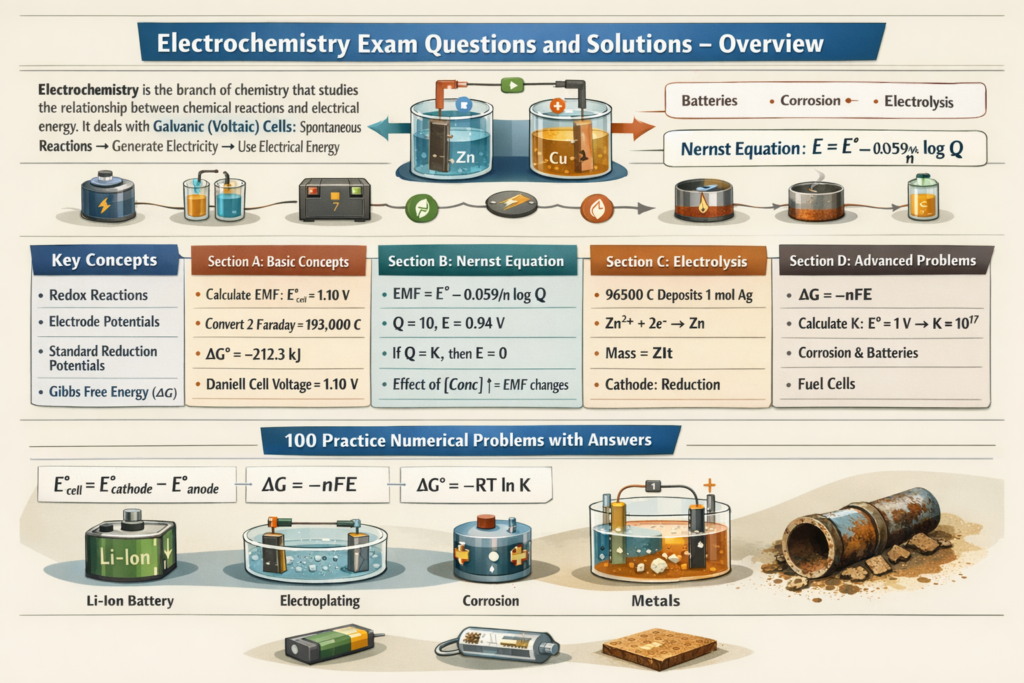
100 Practice Numerical Problems with Answers
Section A: Basic Concepts (1–20)
- Calculate EMF if E°cell = 1.10 V → Answer: 1.10 V
- Convert 2 Faraday into charge → Answer: 193000 C
- Charge required for 1 mole electrons → Answer: 96500 C
- EMF when cathode = 0.34 V, anode = –0.76 V → Answer: 1.10 V
- ΔG° for n=2, E°=1.1 V → Answer: –212.3 kJ
- Oxidation number change in Zn → Answer: +2
- Faradays for 2 mol electrons → Answer: 2 F
- Voltage of Daniell cell → Answer: 1.10 V
- Standard hydrogen electrode potential → Answer: 0 V
- Cell potential if both electrodes equal → Answer: 0 V
- Unit of EMF → Answer: Volt
- Charge of 0.5 mol electrons → Answer: 48250 C
- n-factor of Cu²⁺ → Cu → Answer: 2
- Number of electrons in Fe³⁺ → Fe²⁺ → Answer: 1
- Faraday constant → Answer: 96500 C/mol
- Cathode reaction in Daniell cell → Answer: Cu²⁺ + 2e⁻ → Cu
- Anode reaction → Answer: Zn → Zn²⁺ + 2e⁻
- Sign of ΔG for spontaneous → Answer: Negative
- Relation ΔG and E → Answer: ΔG = –nFE
- Units of ΔG → Answer: Joules
Section B: Nernst Equation (21–40)
- EMF at 298K, n=1, Q=10 → Answer: E = E° – 0.059
- Log(1) → Answer: 0
- If Q=1, E= → Answer: E°
- EMF when Q=100 → Answer: E° – 0.118 V
- If E°=1V, Q=10 → Answer: 0.941 V
- Temperature constant (298K) → Answer: 0.0591
- If n=2, constant → Answer: 0.0295
- EMF decreases when Q → Answer: Increases
- Equilibrium EMF → Answer: 0
- If Q=K → Answer: E=0
- log10 = → Answer: 1
- log100 = → Answer: 2
- Effect of concentration increase → Answer: EMF changes
- Nernst equation unit → Answer: Volt
- E when Q very small → Answer: High
- E when Q large → Answer: Low
- n increases → effect → Answer: Smaller change
- Temperature increases → Answer: EMF changes
- Standard condition temp → Answer: 298K
- Gas constant value → Answer: 8.314 J/mol·K
Section C: Electrolysis (41–70)
- Charge for 1 mol Ag deposition → Answer: 96500 C
- Ag⁺ + e⁻ → Ag, n= → Answer: 1
- Cu²⁺ needs electrons → Answer: 2
- Mass deposited formula → Answer: m = ZIt
- Z unit → Answer: g/C
- Current unit → Answer: Ampere
- 1 A for 1 sec → charge → Answer: 1 C
- 2 A for 10 s → Answer: 20 C
- 96500 C deposits Ag → Answer: 108 g
- 48250 C deposits Ag → Answer: 54 g
- Equivalent weight of Cu → Answer: 31.75
- m ∝ Q → Answer: True
- m ∝ I → Answer: True
- m ∝ t → Answer: True
- Faraday law number → Answer: 2
- Electrolysis is → Answer: Non-spontaneous
- Cathode reaction → Answer: Reduction
- Anode reaction → Answer: Oxidation
- Gas evolved depends on → Answer: Electrolyte
- H₂ formed requires → Answer: 2 electrons
- O₂ formation electrons → Answer: 4
- Charge for O₂ (1 mol) → Answer: 386000 C
- 1F deposits → Answer: 1 equivalent
- Electroplating uses → Answer: Electrolysis
- Unit of Z → Answer: g/C
- Efficiency formula → Answer: Actual/Theoretical ×100
- Current density unit → Answer: A/m²
- Time unit → Answer: sec
- Coulomb definition → Answer: Charge unit
- Electrolyte conducts via → Answer: Ions
Section D: Advanced Numericals (71–100)
- ΔG = –nFE, n=1, E=1 → Answer: –96500 J
- ΔG for n=2, E=1.5 → Answer: –289500 J
- K from E°=1 → Answer: ~10¹⁷
- logK relation → Answer: nE°/0.059
- If E°=0 → Answer: K=1
- E° positive → Answer: K>1
- E° negative → Answer: K<1
- Corrosion is → Answer: Electrochemical
- Rusting involves → Answer: Fe oxidation
- Fuel cell converts → Answer: Chemical to electrical
- Battery stores → Answer: Electrical energy
- Lead-acid battery voltage → Answer: 2 V
- Dry cell voltage → Answer: 1.5 V
- Lithium battery voltage → Answer: ~3.7 V
- EMF unit → Answer: Volt
- Internal resistance unit → Answer: Ohm
- Ohm’s law → Answer: V=IR
- Conductivity unit → Answer: S/m
- Resistivity unit → Answer: Ω·m
- Specific conductance symbol → Answer: κ
- Molar conductance unit → Answer: S·cm²/mol
- Kohlrausch law applies → Answer: Strong electrolytes
- Degree of dissociation → Answer: α
- Weak electrolyte α increases with → Answer: Dilution
- Conductance increases with → Answer: Temperature
- Ionic mobility unit → Answer: cm²/V·s
- Transference number sum → Answer: 1
- Cathode gain mass → Answer: Positive
- Anode loses mass → Answer: True
- EMF independent of → Answer: Size of electrodes