Thermodynamics Chemistry Problems with Solutions (Overview)
Thermodynamics in chemistry is the study of energy transformations, particularly how heat and work are exchanged during chemical reactions and physical processes. It is governed by four fundamental laws, with the First Law focusing on energy conservation, the Second Law explaining entropy and spontaneity, and the Third Law dealing with absolute zero. These principles help predict whether a reaction will occur and how energy flows within a system. Thermodynamic problems often involve calculating internal energy (ΔU), enthalpy (ΔH), entropy (ΔS), and Gibbs free energy (ΔG).
In practical problem-solving, students apply equations like ΔH = q (at constant pressure), ΔG = ΔH – TΔS, and q = mcΔT. These calculations help determine heat absorbed or released, feasibility of reactions, and equilibrium conditions. Many problems also involve calorimetry, Hess’s Law, and bond enthalpies. Mastering these requires understanding both concepts and mathematical manipulation, especially unit conversions and logarithmic relationships in equilibrium thermodynamics.
Thermodynamics problems are essential in exams like SAT Subject Tests, AP Chemistry, and university-level chemistry courses. Practicing numerical problems strengthens analytical thinking and prepares students for real-world applications such as energy efficiency, industrial reactions, and environmental chemistry. Below are 100 practice numerical problems with answers to help reinforce your understanding.
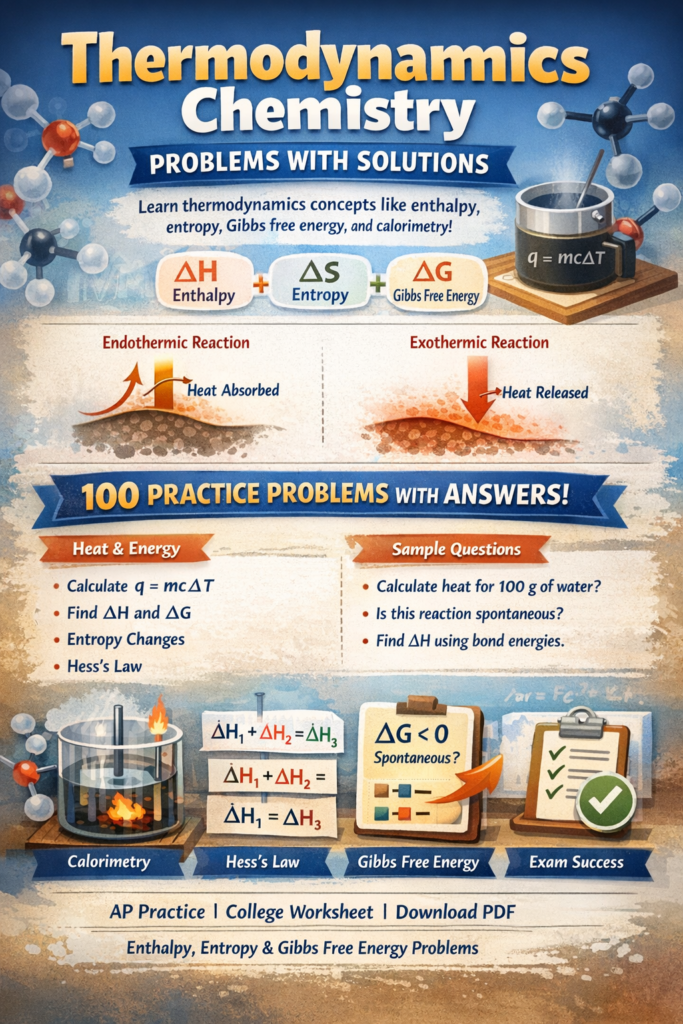
🔥 100 Thermodynamics Numerical Problems (with Answers)
🔹 Basic Heat & Temperature (1–20)
- Calculate heat required to raise 100 g water by 10°C (c = 4.18 J/g°C) → 4180 J
- Heat released when 50 g water cools by 5°C → -1045 J
- Heat needed for 200 g metal (c=0.5) to rise 20°C → 2000 J
- Temperature rise if 1000 J added to 50 g water → 4.78°C
- Heat for 1 kg water, 2°C rise → 8360 J
- Heat loss for 250 g water drop 4°C → -4180 J
- Energy for 100 g copper (c=0.39) +10°C → 390 J
- ΔT if 2000 J to 100 g water → 4.78°C
- Heat needed for 500 g water +1°C → 2090 J
- Heat released 100 g metal drop 15°C (c=0.2) → -300 J
- Energy for 300 g water +3°C → 3762 J
- ΔT if 100 J to 10 g water → 2.39°C
- Heat for 1 g water +100°C → 418 J
- Heat for 100 g ice melt (Lf=334) → 33400 J
- Heat for boiling 50 g water (Lv=2260) → 113000 J
- Heat to cool 500 g by 2°C → -4180 J
- Heat for 150 g water +5°C → 3135 J
- ΔT for 209 J in 10 g water → 5°C
- Heat for 20 g metal (c=0.9) +10°C → 180 J
- Heat loss for 100 g drop 1°C → -418 J
🔹 Enthalpy Changes (21–40)
- ΔH if 500 J absorbed → +500 J
- ΔH if 200 J released → -200 J
- Reaction absorbs 2 kJ → +2000 J
- Releases 5 kJ → -5000 J
- If q=1000 J at constant pressure → ΔH = 1000 J
- Endothermic reaction sign → Positive ΔH
- Exothermic reaction sign → Negative ΔH
- ΔH for combustion given -890 kJ → -890 kJ
- Heat absorbed 3 kJ → +3000 J
- Heat released 1.5 kJ → -1500 J
- ΔH for neutralization ≈ → -57 kJ/mol
- Reaction releases 10 kJ → -10000 J
- If q = -250 J → ΔH = -250 J
- ΔH of formation sign varies → Depends
- Combustion always → Exothermic
- If ΔH > 0 → Endothermic
- If ΔH < 0 → Exothermic
- Energy absorbed 750 J → +750 J
- Reaction releases 8 kJ → -8000 J
- Heat gained → Positive ΔH
🔹 Entropy & Gibbs Free Energy (41–60)
- ΔG = ΔH – TΔS → formula
- ΔG negative means → Spontaneous
- ΔG positive → Non-spontaneous
- ΔS increase means → More disorder
- ΔS decrease → More order
- ΔG = 0 → Equilibrium
- If ΔH negative & ΔS positive → Always spontaneous
- ΔH positive & ΔS negative → Never spontaneous
- ΔG = -500 J → Spontaneous
- ΔG = +200 J → Non-spontaneous
- Entropy unit → J/K
- Temperature unit → Kelvin
- ΔG equation units → J or kJ
- ΔS positive → Disorder increases
- ΔS negative → Order increases
- High T favors → Entropy term
- Low T favors → Enthalpy term
- ΔG = ΔH – TΔS importance → Predicts feasibility
- ΔS gas > liquid → True
- ΔS liquid > solid → True
🔹 Hess’s Law & Bond Energy (61–80)
- Hess law → Add equations
- ΔH total = sum of steps
- Reverse reaction → Change sign
- Multiply equation → Multiply ΔH
- Bond breaking → Endothermic
- Bond forming → Exothermic
- ΔH = bonds broken – formed
- Strong bonds → High energy
- Weak bonds → Low energy
- Formation releases energy → Exothermic
- Breaking absorbs energy → Endothermic
- ΔH depends on bonds
- Double bond stronger than single
- Triple bond strongest
- Bond energy unit → kJ/mol
- ΔH negative means → Stable products
- Reaction energy = bond difference
- Hess law applies to → State functions
- Path independent → Yes
- ΔH total remains same
🔹 Advanced / Mixed (81–100)
- 1 mol gas expands → work done
- Work = PΔV
- Internal energy formula → ΔU = q + w
- If system absorbs heat → q positive
- If system does work → w negative
- Adiabatic process → q=0
- Isothermal → constant T
- Isochoric → constant V
- Isobaric → constant P
- ΔU depends on → state
- Heat capacity Cp > Cv
- Ideal gas → PV=nRT
- R = 8.314 J/molK
- T must be Kelvin
- Pressure unit → atm/Pa
- Volume unit → L/m³
- Energy unit → Joule
- Work unit → Joule
- Heat unit → Joule
- Thermodynamics deals with → Energy changes