Organic Chemistry Reaction Questions and Answers – Overview
Organic chemistry reaction questions and answers PDFs are study resources designed to help students master how organic compounds transform during chemical reactions. These materials typically include reaction mechanisms, reagent conditions, intermediates, and final products. They are especially useful for exam preparation because they condense complex reaction pathways—such as substitution, elimination, addition, and rearrangement—into structured practice problems with clear solutions.
Such PDFs often focus on key reaction types like nucleophilic substitution (SN1, SN2), electrophilic addition, oxidation-reduction, and aromatic substitution. By practicing these questions, students learn to predict products, identify reagents, and understand step-by-step mechanisms. Many also include numerical-style or logic-based problems where students calculate yields, determine molecular formulas, or analyze reaction rates and equilibrium.
Overall, these resources are valuable for building problem-solving skills in organic chemistry. Repeated practice helps students recognize patterns, understand reaction behavior under different conditions, and gain confidence for competitive exams, university tests, or professional entrance exams like SAT, NEET, JEE, or MCAT.
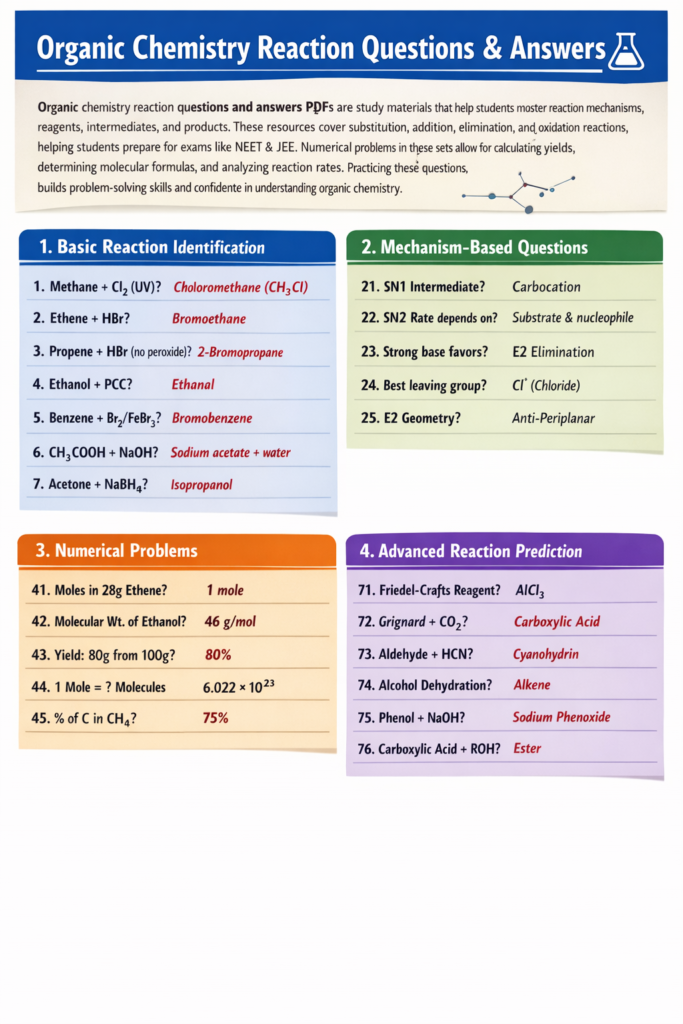
100 Organic Chemistry Reaction Practice Problems (with Answers)
Section 1: Basic Reaction Identification (1–20)
- Identify the product of methane chlorination under UV light.
Answer: Chloromethane (CH₃Cl) - Ethene reacts with HBr. What is the product?
Answer: Bromoethane - Ethene + H₂ (Ni catalyst) → ?
Answer: Ethane - Propene + HBr (no peroxide) → ?
Answer: 2-Bromopropane (Markovnikov) - Propene + HBr (peroxide) → ?
Answer: 1-Bromopropane (anti-Markovnikov) - Ethanol + PCC → ?
Answer: Ethanal - Ethanol + KMnO₄ (strong) → ?
Answer: Ethanoic acid - Benzene + Br₂/FeBr₃ → ?
Answer: Bromobenzene - CH₃Cl + OH⁻ → ?
Answer: Methanol - CH₃CH₂Br + KOH (alc) → ?
Answer: Ethene - Acetylene + H₂ (Lindlar) → ?
Answer: Ethene - Acetylene + excess H₂ → ?
Answer: Ethane - Propanol + H₂SO₄ (heat) → ?
Answer: Propene - Benzene + HNO₃/H₂SO₄ → ?
Answer: Nitrobenzene - Toluene + KMnO₄ → ?
Answer: Benzoic acid - Ethene + Br₂ → ?
Answer: 1,2-Dibromoethane - CH₃COOH + NaOH → ?
Answer: Sodium acetate + water - Esterification: Ethanol + Acetic acid → ?
Answer: Ethyl acetate - CH₃CH₂OH + SOCl₂ → ?
Answer: CH₃CH₂Cl - Acetone + NaBH₄ → ?
Answer: Isopropanol
Section 2: Mechanism-Based (21–40)
- SN1 reaction intermediate type?
Answer: Carbocation - SN2 reaction rate depends on?
Answer: Substrate + nucleophile - Which is faster SN1: tertiary or primary?
Answer: Tertiary - Strong base favors which elimination?
Answer: E2 - Weak base favors?
Answer: E1 - Carbocation rearrangement occurs in?
Answer: SN1/E1 - Best leaving group: Cl⁻ or OH⁻?
Answer: Cl⁻ - Nucleophile strength increases with?
Answer: Negative charge - Polar protic solvent favors?
Answer: SN1 - Polar aprotic solvent favors?
Answer: SN2 - E2 requires what geometry?
Answer: Anti-periplanar - Rate of SN2 increases with?
Answer: Less steric hindrance - Tertiary halide + strong base → ?
Answer: Elimination - Primary halide + strong nucleophile → ?
Answer: Substitution (SN2) - Carbocation stability order?
Answer: 3° > 2° > 1° - Hyperconjugation stabilizes?
Answer: Carbocations - Inductive effect depends on?
Answer: Electronegativity - Aromatic substitution involves?
Answer: Electrophiles - Rate-determining step in SN1?
Answer: Carbocation formation - SN2 inversion of configuration called?
Answer: Walden inversion
Section 3: Numerical/Calculation-Based (41–70)
- Moles of ethene in 28 g?
Answer: 1 mole - Molecular weight of ethanol?
Answer: 46 g/mol - 1 mole ethene gives how many moles ethane (hydrogenation)?
Answer: 1 mole - Yield = (actual/theoretical) × 100. If actual = 80g, theoretical = 100g?
Answer: 80% - Density = mass/volume. If 46g occupies 1L?
Answer: 46 g/L - % composition of carbon in CH₄?
Answer: 75% - Degree of unsaturation for C₄H₈?
Answer: 1 - Empirical formula of C₂H₄?
Answer: CH₂ - Number of isomers of C₄H₁₀?
Answer: 2 - 1 mole = ? molecules
Answer: 6.022×10²³ - pH of neutral solution?
Answer: 7 - 10 moles ethanol mass?
Answer: 460 g - Avogadro number value?
Answer: 6.022×10²³ - Molecular formula from empirical CH₂, molar mass 28?
Answer: C₂H₄ - Combustion of 1 mole methane gives CO₂ moles?
Answer: 1 mole - Boiling point increases with?
Answer: Molecular weight - 2 moles H₂ needed for 1 mole alkyne → alkane?
Answer: Yes - Heat of reaction sign (exothermic)?
Answer: Negative - Reaction rate unit?
Answer: mol/L·s - Catalyst affects?
Answer: Rate, not equilibrium - Equilibrium constant depends on?
Answer: Temperature - Half-life formula for first order?
Answer: 0.693/k - Increase temp increases rate because?
Answer: More collisions - Activation energy unit?
Answer: kJ/mol - Ideal gas equation?
Answer: PV = nRT - R value?
Answer: 8.314 J/mol·K - Molarity = ?
Answer: moles/liter - 1 L = ? mL
Answer: 1000 mL - Reaction quotient equals K at?
Answer: Equilibrium - Endothermic reaction absorbs?
Answer: Heat
Section 4: Advanced Reaction Prediction (71–100)
- Friedel–Crafts alkylation reagent?
Answer: AlCl₃ - Grignard reagent reacts with CO₂ → ?
Answer: Carboxylic acid - Aldehyde + HCN → ?
Answer: Cyanohydrin - Ketone reduction → ?
Answer: Secondary alcohol - Aldehyde oxidation → ?
Answer: Carboxylic acid - Alcohol dehydration → ?
Answer: Alkene - Haloalkane + NH₃ → ?
Answer: Amine - Benzene nitration temp ~?
Answer: 50°C - Phenol + NaOH → ?
Answer: Sodium phenoxide - Carboxylic acid + alcohol → ?
Answer: Ester - Alkene ozonolysis → ?
Answer: Carbonyl compounds - Butene ozonolysis gives?
Answer: Aldehydes/ketones - Lucas test detects?
Answer: Alcohol class - Tollens test detects?
Answer: Aldehydes - Fehling solution gives?
Answer: Red precipitate - Aromatic ring activator example?
Answer: –OH - Deactivator example?
Answer: –NO₂ - Ortho-para director example?
Answer: –CH₃ - Meta director example?
Answer: –COOH - Polymerization of ethene gives?
Answer: Polyethene - Nylon formation type?
Answer: Condensation polymer - Soap formation reaction?
Answer: Saponification - Ester hydrolysis gives?
Answer: Acid + alcohol - Amide hydrolysis gives?
Answer: Acid + amine - Alkyl halide + metal → ?
Answer: Organometallic - Benzene hydrogenation → ?
Answer: Cyclohexane - Ether cleavage with HI → ?
Answer: Alcohol + alkyl iodide - Aldol condensation product?
Answer: β-hydroxy aldehyde - Cannizzaro reaction occurs in?
Answer: Non-enolizable aldehydes - Diels–Alder reaction forms?
Answer: Cyclohexene derivative